The digital marketing landscape has been fundamentally reshaped. For years, agencies perfected the science of Google SEO. Today, a new, conversational search frontier has emerged, and clients are asking the one question you need to be able to answer: “How does our brand look on ChatGPT?”
If you’re an agency, your clients are no longer just searching for information; they’re conversing with AI to get it. This shift from keyword to conversation has created a massive blind spot. How do you monitor, measure, and improve your clients’ visibility inside AI chat models like ChatGPT, Claude, and Google’s AI?
Many agencies begin this journey by searching for white label AI chat visibility tools. The impulse makes sense: you want to present a seamless, fully-branded solution to your clients. However, in this nascent and highly technical field, a different model is proving to be more powerful, transparent, and effective: co-branding.
This guide will explore why co-branded solutions are becoming the agency standard for AI chat monitoring and introduce the top platforms that help you provide this critical service.
White-Label: A third-party tool is fully rebranded to look like your agency’s own software. The original provider is invisible to your client.
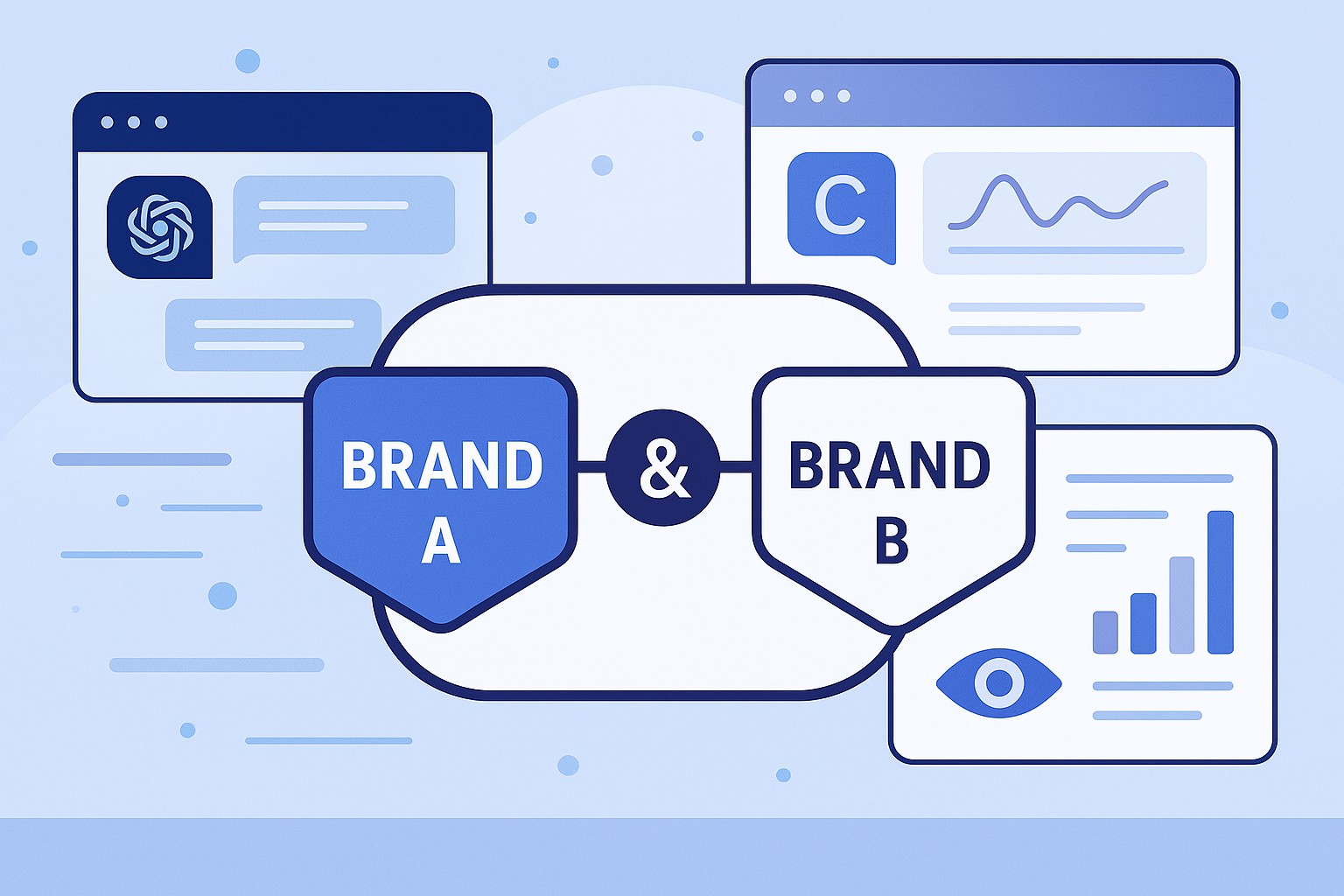
Co-Branded: Both your agency’s brand and the tool provider’s brand appear on reports and dashboards. This frames the relationship as a strategic partnership: your agency’s expertise powered by best-in-class, specialized technology.
Why Co-Branding Beats White-Labeling for AI Chat Visibility
While the search for a white label generative AI marketing platform is common, the savviest agencies are pivoting to a co-branded approach. In a field as new and complex as AI visibility, transparency and authority are your greatest assets.
1. Instant Authority and Trust
When you use a co-branded tool, you aren’t just selling your agency’s expertise; you’re leveraging the specialized authority of a dedicated technology partner. When you show a client a report “Powered by [Specialist Tool Name],” it builds immediate trust. It shows you’ve done your research and partnered with a leader in a niche field, rather than trying to build or (or pretend to have built) a complex solution from scratch.
2. Focus on Strategy, Not Software
Agencies excel at strategy, interpretation, and action. Your value isn’t in building the monitoring tool; it’s in using the data from that tool to get client results. A co-branded solution frees you from the technical overhead of managing a white-labeled instance and lets you focus on what you do best:
- Analyzing the AI mention data.
- Identifying content gaps and opportunities.
- Developing an “AI Optimization” (AIO) strategy.
- Reporting on real-world improvements.
3. Superior Technology and Faster Innovation
The world of generative AI is moving at a breakneck pace. A company 100% dedicated to AI chat visibility will always innovate faster than a general-purpose marketing platform that adds AI monitoring as an afterthought.
Platforms that offer co-branding are typically specialists. They are laser-focused on tracking new models, refining query methodologies, and improving recommendation engines. By co-branding, your agency gets to pass on the benefits of that cutting-edge innovation directly to your clients.
4. Honest and Transparent Client Relationships
The “white-label” model can be fragile. What happens if the tool has downtime? What if a savvy client discovers the underlying provider? It can create a sense of distrust.
A co-branded approach is fundamentally more honest. You’re telling your client, “To provide you with the best AI chat presence monitoring and improvement tools, we have partnered with the industry’s best data provider. We will use this data to drive your strategy.” This transparency strengthens the client-agency relationship.
The market for these tools is exploding. While many traditional SEO platforms are scrambling to add features, a new class of specialists has emerged. These are the AI chat optimization tools for agencies that you should be evaluating.
1. RivalSee
As one of the first platforms designed specifically for this new landscape, RivalSee is built from the ground up to help agencies and brands monitor and optimize their visibility within generative AI.
It directly addresses the core agency need: “How do we get our clients mentioned more often (and more positively) in AI-generated answers?”
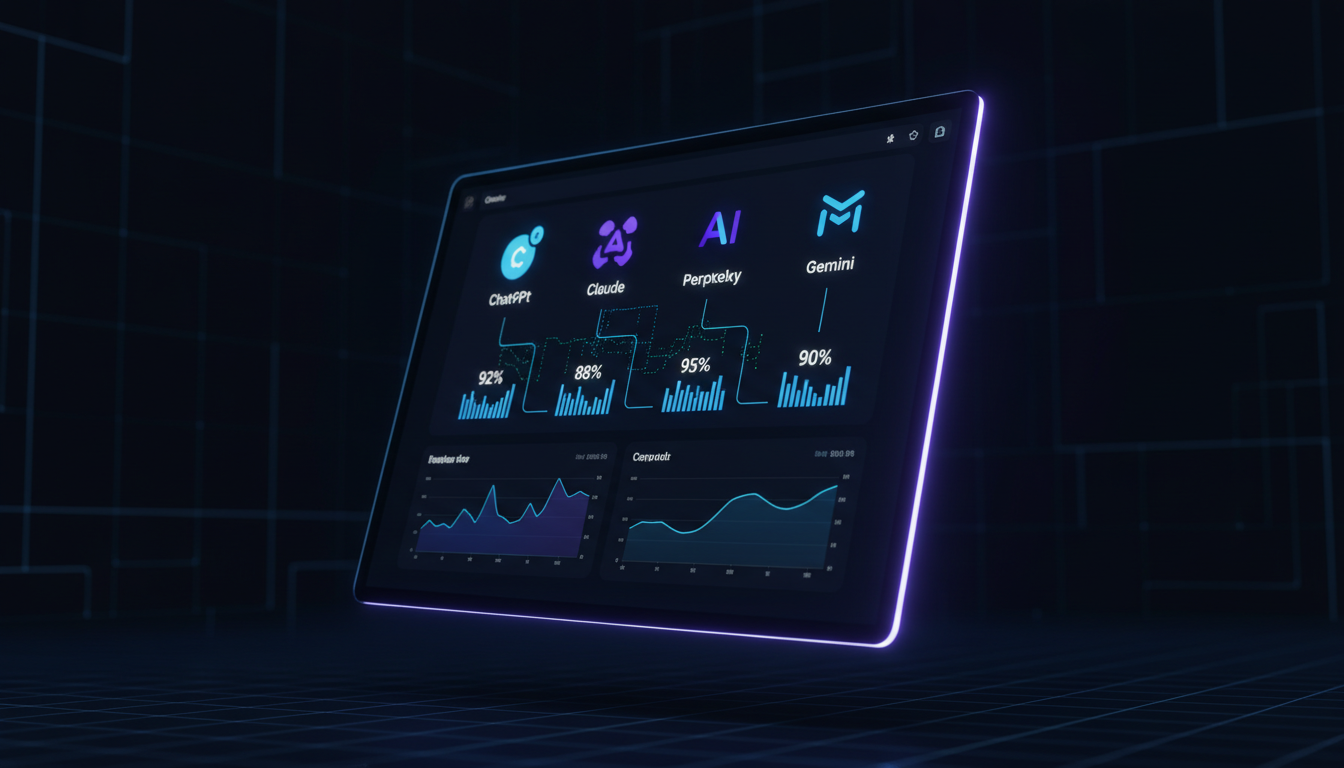
What It Does: RivalSee simulates real customer conversations at scale across multiple AI engines (including ChatGPT-4, Claude 3, Google AI, and Perplexity). It tracks how often your client’s brand (and their competitors) are mentioned in response to critical, high-intent queries.
Key Strengths for Agencies:
- Persona-Driven Queries: Instead of just tracking keywords, you can create user personas (e.g., “a marketing manager looking for CRM software”) and track how the AI recommends brands to that specific persona.
- Multi-Engine Tracking: It provides a unified dashboard to see your client’s visibility across all major large language models (LLMs).
- Actionable Recommendations: The platform doesn’t just show you data; it analyzes the AI’s responses and your client’s (and competitors’) web content to provide specific, actionable advice on what content to create or optimize.
- Co-Branding Model: RivalSee is designed for agency partnerships. You can generate sophisticated, co-branded reports that feature your agency’s logo alongside RivalSee’s. This allows you to deliver powerful, data-driven insights under your brand, backed by the authority of a specialist platform.
2. Semrush
The established SEO giants are rapidly adapting. Semrush has long been an agency favorite for its powerful co-branded and white-label reporting features. They are actively integrating AI-driven features.
What It Does (in this context): Semrush is expanding its brand monitoring and position tracking tools to incorporate data from AI-powered search results (like Google’s SGE, or AI Overviews).
Key Strengths for Agencies:
- Integrated Suite: If you already use Semrush for SEO, PPC, and content marketing, adding their AI visibility features (as they mature) creates a seamless, all-in-one reporting experience.
- Familiar Reporting: Their agency-focused tools are robust, allowing for co-branded PDF reports that integrate AI visibility data alongside traditional SEO KPIs.
- Co-Branding Model: Semrush has one of the most flexible agency reporting systems, allowing for deep customization and co-branding.
3. Ahrefs
Similar to Semrush, Ahrefs is another cornerstone of the SEO industry that is pivoting to address generative AI. Their strength has always been in their powerful backlink index and content analysis tools.
What It Does (in this context): Ahrefs is likely to focus on how AI models source their information. Their tools can help you identify which of your client’s pages are being used as citations in AI answers, giving you a path to influence those answers.
Key Strengths for Agencies:
- Content-First Approach: Ahrefs is excellent for finding content gaps and opportunities, which is a core part of any AIO (AI Optimization) strategy.
- Data-Rich Analysis: Agencies can use Ahrefs’ domain and page-level metrics to prioritize which content to optimize for AI inclusion.
- Co-Branding Model: Ahrefs offers reporting features, though they have historically been less focused on the “white-label” agency model than Semrush. Co-branded dashboards and data exports are common.
It’s crucial to understand a key difference. The keywords white label AI chatbot platforms for agencies refer to a different category of tool.
AI Chat Visibility Tools (e.g., RivalSee): These tools monitor your brand’s presence inside external, third-party AI models like ChatGPT and Claude. The goal is to see if they recommend you.
AI Chatbot Platforms (e.g., Tidio, Intercom, Custom Bots): These platforms help you build an AI chatbot for your client’s own website. The goal is to improve on-site conversion and support.
While both are “AI tools,” they solve completely different agency problems. Your client’s immediate blind spot isn’t their on-site bot; it’s what the world’s most popular AI models are saying about them. This is why a dedicated AI chat visibility tool is the more urgent need.
Key Features to Demand from Your Co-Branded AI Visibility Partner
When you evaluate AI chat optimization tools for agencies, don’t be wowed by a simple keyword tracker. This new frontier requires a more sophisticated approach. Here’s a checklist of must-have features.
1. Multi-Engine Support
The market is not a monolith. A client’s visibility on ChatGPT might be completely different from their presence on Google’s AI or Perplexity. Your tool must be able to track and compare performance across all major LLMs.
2. Persona-Based & Conversational Querying
Users don’t just type “best CRM” into ChatGPT. They say, “I’m a small business owner in real estate. What’s the easiest-to-use CRM for managing my client list?” Your tool needs to go beyond basic keywords and simulate these complex, persona-driven conversational queries. This is a key area where a specialist platform like RivalSee shines, as its entire methodology is built on this principle.
3. Competitor Benchmarking
It’s not enough to know your client’s “mention rate.” You need context. How does that rate compare to their top three competitors for the same set of high-intent queries? A good tool will show you a share-of-voice (SOV) map for the new AI landscape.
4. Source & Citation Tracking
When the AI does mention your client, why? A top-tier tool should attempt to identify the source articles, data, or web pages the AI used to formulate its answer. This gives your agency a direct-hit list of content to optimize, update, or promote.
5. Actionable, Content-Focused Recommendations
This is the feature that separates a simple monitoring tool from an optimization platform. The tool shouldn’t just give you a dashboard of data; it should give you a “to-do” list.
- “The AI prefers competitors A and B for this query because their content focuses on ‘ease of use.’ Your client’s content does not.”
- “Your client was not mentioned. To improve visibility, create a new blog post titled ‘The Top 5 Features of [Client Product] for Real Estate Agents.’”
6. Robust, Agency-Friendly Co-Branded Reporting
Finally, the tool must make you look good.
- Can you add your own logo?
- Can you schedule automated reports to be sent to clients?
- Is the interface clean, professional, and easy for a non-technical client to understand?
This is where you’ll see the true value of a co-branded partnership over a clunky attempt to monitor AI chat mentions for clients white label using a repurposed tool.
A 4-Step Strategy to Monitor and Improve Client AI Chat Visibility
Once you’ve partnered with a co-branded tool, here is the simple, high-value service you can immediately begin offering to your clients.
Step 1: Establish the Baseline
Before you do anything else, you need to show the client their starting point. This begins with understanding who they’re trying to reach.
- Define the ICP (Ideal Customer Profile): Start by identifying your client’s ideal customer segments. What industries do they serve? What company sizes? What pain points are they solving?
- Create Personas: Within each ICP, develop specific buyer personas that represent the real people searching for solutions. What’s their role? What questions are they asking AI assistants? What language do they use?
- Automated Persona Generation: Tools like RivalSee will automatically create these ICPs and personas for your clients, saving you hours of research and interviews.
- Queries: Once personas are established, identify the 20-30 most important, high-intent queries each persona would ask.
- Competitors: Identify their top 3-5 competitors.
- Report: Run the analysis across all major AI engines. This initial report is often a massive “aha!” moment for clients. It’s the first time they’ve ever seen this data, and it immediately establishes the need for your new service.
Step 2: Analyze & Strategize
With the baseline report in hand, your agency’s strategic work begins.
- Identify Gaps: Where are competitors winning?
- Find Opportunities: Are there high-intent queries where no one is mentioned? This is a wide-open opportunity.
- Analyze Sentiment: When the client is mentioned, is the context positive? Is it accurate?
- Develop the “AIO” Plan: Create a content plan based on the tool’s recommendations. This is the core of AI chat presence monitoring and improvement tools for digital marketing agencies.
Step 3: Execute the Content & Optimization Plan
This is your bread-and-butter. Armed with data, you can now execute a highly targeted content strategy.
- Create New Content: Write the specific articles, guides, and FAQs the AI is looking for.
- Optimize Existing Content: Update your most important pages to include the facts, features, and language the AI models are clearly favoring.
- Structured Data & E-E-A-T: Ensure all content is well-structured, factually accurate, and demonstrates clear Expertise, Authoritativeness, and Trustworthiness (E-E-A-T). AI models love this.
Step 4: Monitor, Report, and Iterate
This is where the co-branded reports become your MVP (Most Valuable Player). On a monthly or quarterly basis, you re-run the analysis.
- Show the client, “Last quarter, you were mentioned in 5% of responses for this query. After our new content campaign, you are now mentioned in 22% of responses.”
- Use the co-branded report to clearly demonstrate ROI. The data from the platform proves your strategy is working.
- Identify the next set of queries to target and repeat the cycle.
Conclusion: Become the Agency That Answers the New Questions
The ability to monitor AI chat mentions for clients is no longer a futuristic “nice-to-have.” It is a fundamental requirement for digital agencies in 2026 and beyond.
While the initial instinct might be to find a white label AI chat visibility tool, the smarter, more sustainable, and more authoritative move is to embrace a co-branded partnership. By pairing your agency’s strategic expertise with a best-in-class, specialized data platform, you deliver unparalleled value to your clients.
You aren’t just giving them a new dashboard; you’re giving them visibility into the most important new marketing channel of the decade. And you’re providing a clear, actionable plan to win it.